Photo retouching vs. photo editing: The differences, explained
So you glanced over your photographer’s timeline and spotted there’s a line in there about photo editing … but maybe you don’t want your photographer retouching your photos because you want to keep things all-natural. Or maybe it’s the opposite. You were really hoping for some photo retouching, and you’re not sure you need editing done after your shoot.
Confused? Welcome to the wonderful world of baffling photography words. I’m your host, a photographer who was also the voice of a dictionary (yes, really), and I’m about to answer all your “wait, huh, why?” questions.
What’s the difference between photo retouching and photo editing? Do they count as photo manipulation? Is retouching a picture the same as editing a photo, or are they entirely different things? If it’s the latter, which one should I ask for when I spill my coffee all over my outfit on the way to my headshot session? And wait a second, where does airbrushing come into all of this?
These are all “what’s going on behind the scenes?” questions people love to ask photographers like me mid-session, usually after they’ve asked if I can zap away that zit that sprouted overnight (yes) or make them look 10 pounds lighter (it’s complicated).
Thanks to programs like Photoshop and filters on social media platforms like Snapchat and Instagram, decades of the fashion and beauty industry rebuilding entire bodies and presenting them as “real,” and the proliferation of AI slop on the internet, it’s no surprise people want to know more about what really happens to your family or wedding photo between the time it’s taken and the time it shows up on your phone screen.
With that in mind, I’m going to break it all down for you (as easily as I can).
Grab your favorite beverage, and get comfy because I’m about to dig into the backstory on photo editing and give you a behind the scenes look at what I do when I edit photos after a session or a wedding. plus I’ll dive into the difference between photo retouching and photo editing (yes, they’re two entirely different things, and they bring up big, capital F feelings for a lot of folks), and take a quick detour into defining airbrushing.
To top it all off, you’ll get a look at my personal policies on what I will retouch … and what I won’t.
Ready? Set? Let’s get nerdy about a set of words photographers throw around like birdseed at a wedding!
What is photo manipulation (and where did it all start)?
Before I can get into retouching, editing, or even airbrushing, I need to talk about what it actually means to manipulate a photo.
Photo manipulation has been getting a lot of attention these past few years from altered photos of Kate Middleton creating yet another scandal for the British royal family to AI-generated deepfakes that have turned your social media feed into a daily game of “is it real?”
I wish it could go without saying, but it can’t, so let me be crystal clear: I do not advocate altering or manipulating photos to trick or scam those who view them. As a photographer who got her start as a photojournalist, capturing photos for a newspaper, I am guided by an ethical obligation to ensure my photos are not intentionally misleading or harmful to my subjects.
Now for the part that may surprise you: The ethical line isn’t between “real” photos and “manipulated” photos.
Photo manipulation is something that ethical, responsible photographers do on a daily basis.
And yes, it’s been that way for centuries.
A quick (I promise) history lesson in manipulating photos
Photos have never gone directly from a camera to someone’s living room wall. They can’t.
Think about a pastry chef whipping up your favorite sweet treat. They’re manipulating the eggs, flour, sugar, and all those other ingredients to put out the batch of cookies you can’t stop wolfing down.
Photographers do the same thing. We manipulate a set of ingredients to create your favorite family photograph.
Sure, those ingredients are different. Unless I’m capturing your family’s holiday baking (which is a whole lot of fun, so please invite me!), there aren’t a ton of eggs or bags of sugar involved in making a photograph. But go back through the decades before digital cameras came on the scene, and there’s always been a set of raw ingredients at the start of the photo process.
Back in the darkroom era, the first raw ingredient was the negative strip that came out of a film camera.
Photographers took that coiled up strip of negative film into a room lit by a dim red glow. There they would mix up a batch of chemicals and set to work with light sensitive paper, turning a thin strip of cellulose into a print ready to be matted and framed. The choices they made in that room, how much light they used to expose one spot or how long they allowed the paper to sit in a chemical tray, all guided the result.
In the digital era, the ingredients have changed. Tapping the shutter button on a camera produces a RAW file in place of a film strip, and software like Adobe’s Lightroom and Photoshop have taken the place of the chemicals and dim red bulb. Now we make choices on a computer screen, sliding one tool bar to the left and another to the right, to turn a data file into the 8 x 10 you’ll gift to Grandma this holiday season.
But every photo is different, and sometimes that recipe has to change.
That’s where photo retouching and editing come in.
What is photo retouching?
So let’s talk about photo retouching. You’ve probably heard the phrase used over the years, and I’m willing to bet big that you’ve heard it used in some pretty negative ways.
In its simplest form, photo retouching is enhancing or correcting specific elements or details within an image. The goal of photo retouching is to remove imperfections. That can mean anything from the bright red zit that broke out on a small business owner’s chin the day before their personal branding session to that smear of chocolate on a toddler’s cheek from the M&M’s they found on the car ride to their family session.
What does this look like in reality? Some of the techniques that would fall under the photo retouching umbrella are:
- Smoothing skin
- Removing acne
- Fixing broken teeth or whitening teeth
- Body shaping
- Brightening/sharpening a subject’s eyes
Are photo retouching and airbrushing a photo the same thing?
If you’re thinking “wait a second, I’ve heard of this, but I’ve always heard it referred to as airbrushing,” well, yes. The English language is chock full of different words that say the exact same thing. Photo retouching and airbrushing are the exact same thing with two totally different names.

Both involve “touching up” a photo or “brushing away” so-called imperfections.
Which leads us to the big elephant in the room …
Why is photo retouching so controversial?
Whether you call it airbrushing or photo retouching, the goal of the process is not to alter the overall composition or style of the image, just to affect one particular part of the overall photo.
So why is it so controversial? Let’s just say that retouching covers a VERY broad range of techniques and decisions made on a computer screen.
I mentioned removing a smear of chocolate on a toddler’s face. That’s retouching (or airbrushing), and it sounds pretty low-key. Who hasn’t had a “oh shoot, my meal got messy on me” moment? If you’re hoping to use this photo for your family’s holiday cards, maybe you don’t want the remnants of snack time preserved for the ages on your grandma’s fridge.
But retouching is also the name for a fashion photo editor using a computer program to smoothe away a model’s curves, changing the overall shape of their body until the person who is a size 12 in real life is very suddenly a size 2. Airbrushing can just as easily refer to removing a person’s wheelchair to make them appear as though they were sitting on a standard kitchen chain, or digitally adding an arm to someone with a limb difference.
There are plenty of studies out there that show the extensive retouching that’s long been rampant in fashion and beauty magazines and advertisements has had pretty negative effects on society. Google “girls’ self esteem” study, and you’ll find myriad studies on the problems that these falsified images have wrought.
Is photo retouching ever OK?
I prefaced this section with “my policy,” because I recognize that retouching is controversial and very, very personal. I’ve had clients over the years who have specifically asked for retouching on their bodies, purposely asking me to me to eliminate acne scars or remove a cold sore that popped up the day before their photo session.
I DO provide photo retouching, within reason. What do I mean by that?
Here’s where I draw my lines in the sand:
- I do not retouch anything permanent. Your body is your body, and I am not here to judge you. I am here to celebrate you and your story!
- I will remove minor impermanent things such as food on a toddler’s chin or a stain on a t-shirt. BUT I only do this on formal portraits. These are part of a lifestyle story, and they’re especially important in documentary sessions. That said, if I notice something like this prior to a session beginning, it is something I will mention to so my client can decide whether or not they want to clean the child’s face/change an outfit.
- If someone asks for retouching, I consider the request one at a time. I’d like to say I had a blanket policy here, but as an eating disorder survivor, as a mom, as a human, I have to treat requests to retouch an adult (coming from that adult) differently than I would requests to retouch a child (coming from that child’s parent). I am not here to tell you how to parent. I am here to tell you that I will not “make a 16-year-old look thinner.”
Photo retouching services
My photo retouching services will not turn you into Gisele Bundchen (sorry?). My goal is to enhance your natural beauty, not create a different version of you.
But we have all had that angry zit pop up the day before a photo session, so I am happy to provide retouching services for the following:
- Acne removal
- Smoothing frizzy hair or fixing out-of-place strands
- Limited teeth whitening (natural adjustments)
- Light skin smoothing for a polished look
- Reducing under-eye circles or smile lines
- Minimizing the appearance of bruises or scratches
- Removing lint or small stains on clothing
- Lightening or darkening areas of uneven tan lines
- Subtle adjustments to correct lighting or shadows on the face
- Removal of cold sores, boogers, stray mascara or lipstick
- Adjusting minor wardrobe malfunctions (e.g., sneaky bra straps or crooked bow ties)
- Reducing glare on glasses (when possible)
What’s photo editing, and how is it different from photo retouching?
OK, so I don’t do a whole lot of photo retouching … but every single session goes through a round of hand photo editing. What’s going on here?
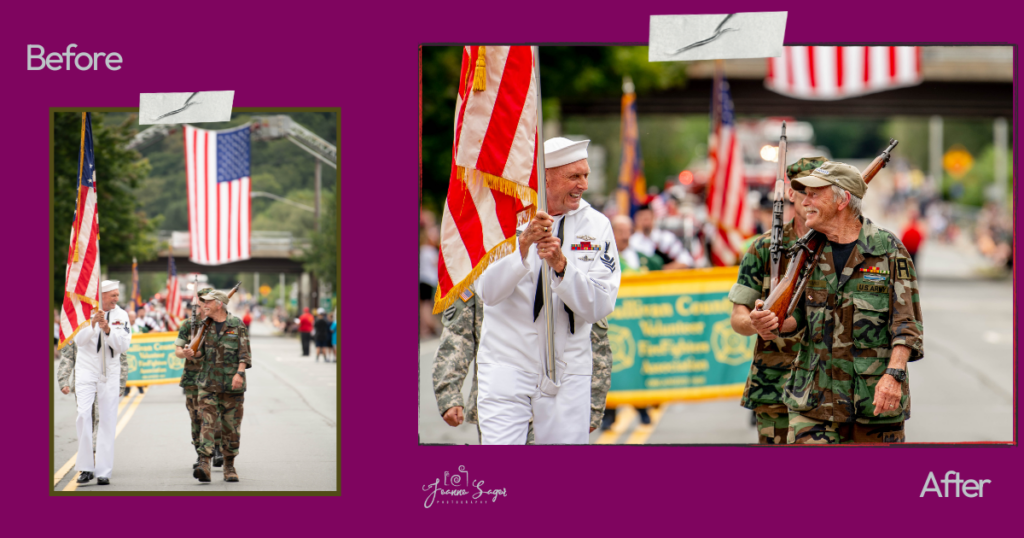
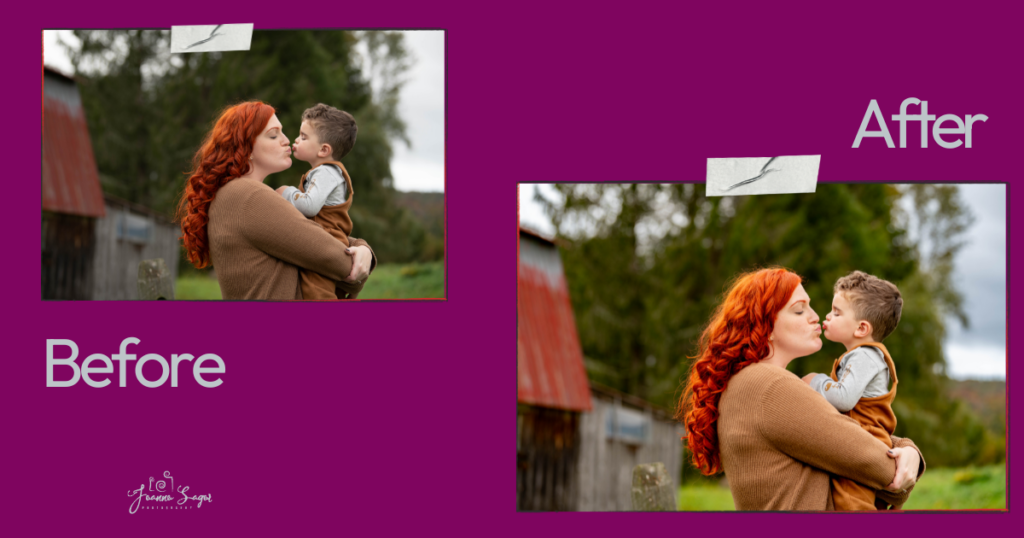
As I touched on earlier, photo retouching and photo editing are two entirely different processes. Instead of focusing on a single detail or group of details, photo editing involves improving the composition or aesthetics of the image as a whole.
Photo editing includes a variety of techniques, including:
- Cropping
- Adjusting the brightness or darkness of a photo
- Correcting the overall balance of colors
- Adjusting the contrast
- Removing unwanted objects (such as photo bombers!)
- Creating black and white versions of color images
My photo editing policy
Every photo that I send to clients has gone through a round of photo editing. Why? The simplest reason is that I take photos in a format known as RAW. Just as the name implies, these RAW format images aren’t final! They’re, well, raw!
RAW is a large file format (so large it takes up an incredible amount of space on my hard drives) that professional photographers use because it prevents the camera from making decisions about the final composition of an image for us. It captures more information from the scene, which we can then use to make our final adjustments on the computer.
Most amateur photographers use a format known as JPEG (or JPG), which creates much smaller files that take up less space on your computer and are used for printing. Clients may even notice that the files I deliver are in this JPEG format for that very reason. They can save space and easily use them for printing. The problem with using this format during the photographing process, however, is the camera will compress the files and you’ll lose all that extra information.
Believe it or not, this harkens back to the olden days of dark room photography. The photo edits that photographers and photo editors make today under the name of editing are the exact sort of adjustments that used to be made in a darkroom to take the “raw” negative and create a polished photo.
Can you just fix this?
At the end of the day, the question most people want to know is “can you fix this?” The answer comes back to what “this” is. It’s one thing to “fix” the fly that buzzed into view beside your head in a single photo or even a few photos. It’s another thing entirely to “fix” an ex-boyfriend who is slam bang in the center of every family group shot.